For mid-market and enterprise
Compare U.S. landed-cost scenarios before committing
Compare illustrative landed-cost scenarios and see Greenwich’s actual interface with synthetic records, pending broker review and unpriced options made explicit.
General information, not a duty quotation. Shipment-specific conclusions require licensed customs broker review.
A lower purchase price is not always a lower landed cost.
This example compares two hypothetical sourcing offers for the same 10,000-unit commercial requirement. It is an arithmetic demonstration, not a tariff determination, product recommendation, customer result or live output from Greenwich software. The assumed duty percentages below are invented inputs for sensitivity testing. They do not correspond to a country, HTS code or current tariff program.
Both offers assume the same specification, quality, quantity and service level. Commercial viability, supplier capacity and product compliance are not established. The buyer is a Europe-based company planning U.S. expansion, but neither offer is assigned a customs origin from that headquarters location.
Inside Greenwich: compare options without hiding uncertainty.
Actual Landed Cost Desk screens, recorded on 7 September 2026 in an isolated test workspace. Supplier identities, quotes and classification inputs are synthetic and preloaded. No AI classification or licensed-broker review was performed for this recording. The screens are not current tariff advice, customer results or a production account.
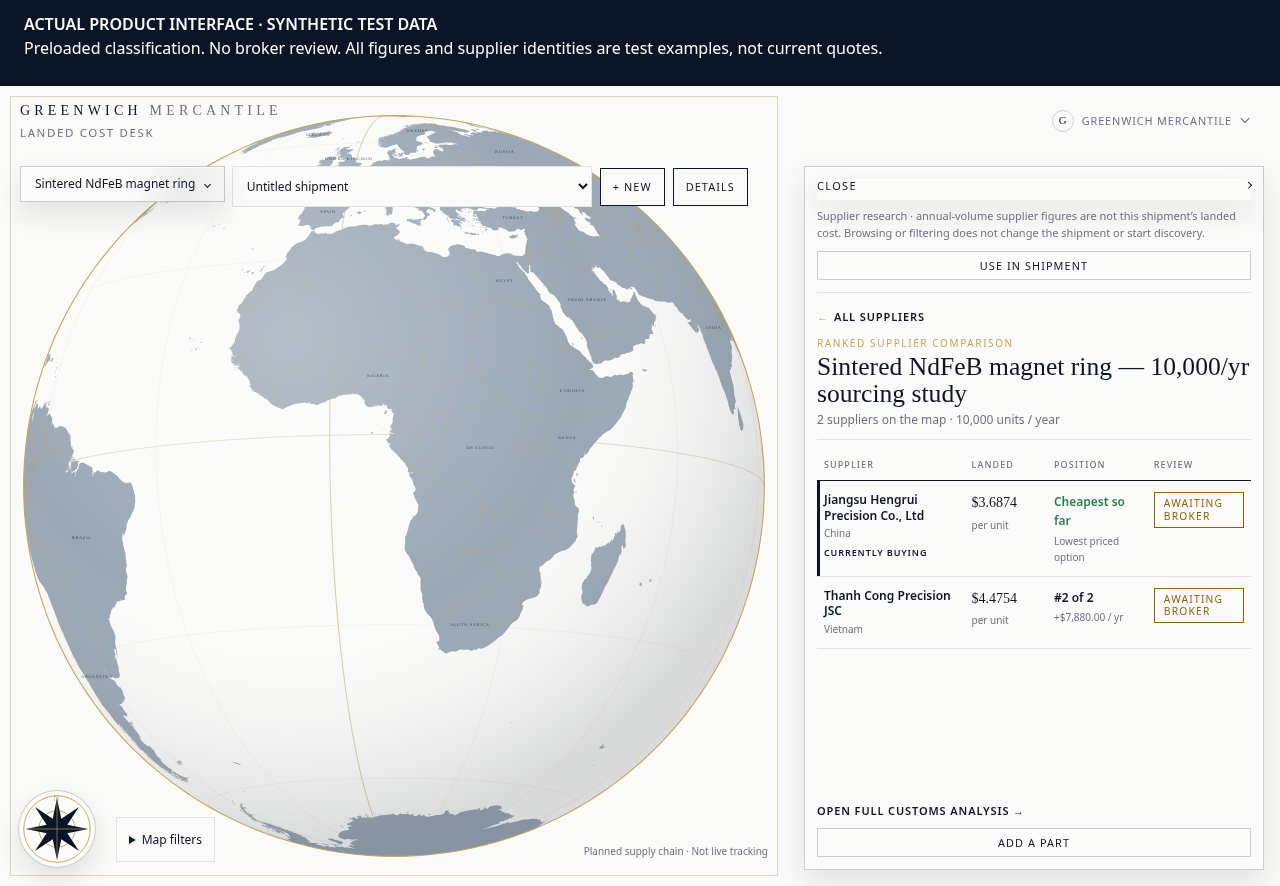
1. Compare offers. Keep review status separate.
Two quoted options appear side by side for the same sample part and annual quantity. Both still say Awaiting broker. A lower displayed cost does not establish an approved import decision. These annual-volume sourcing figures are not the landed cost of a particular shipment.
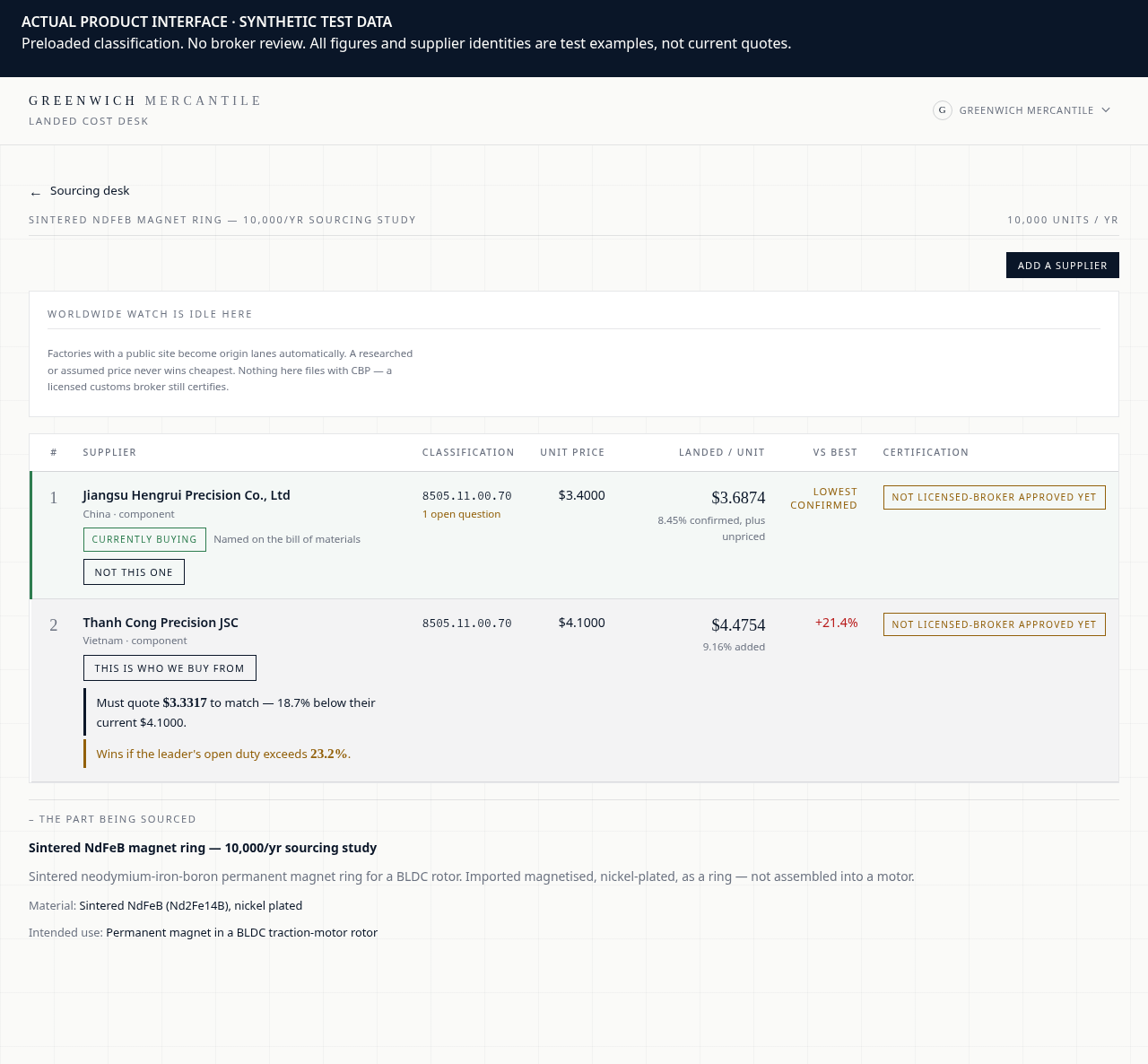
2. Open the assumptions and unresolved questions.
The full analysis shows the entered part description, material and intended use, a preloaded classification, an open question and conditional break-even figures. This makes the comparison inspectable instead of reducing the decision to a single cheapest number. Any confirmed labels refer to the test record, not a current duty determination.
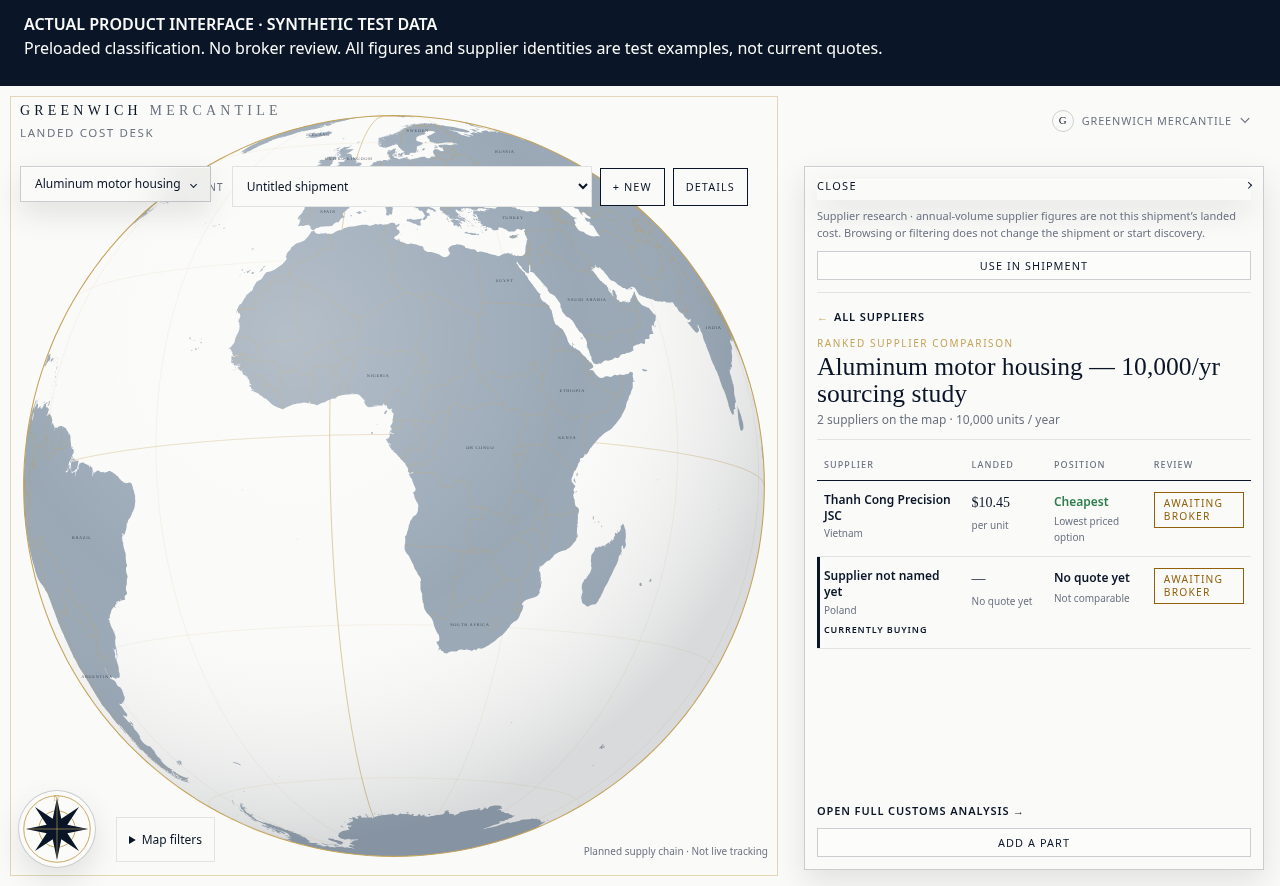
3. Keep missing information visible.
A second sample part includes a Poland option with no supplier quote. It remains No quote yet and Not comparable, not a zero-cost winner. Missing evidence stays a question for the sourcing team rather than becoming an invented saving.
What this proves: the existing interface displays comparable quoted options, conditional thresholds and unresolved review or pricing states. What it does not prove: live document extraction, fresh AI analysis, a completed broker review, current tariff accuracy, an ERP/TMS connection or end-to-end filing. Those steps need a scoped demonstration using your facts and agreed responsibilities.
Plan a scoped enterprise evaluationWalk the decision, not just the calculation.
Illustrative workflow, not live product output. Follow one hypothetical 10,000-unit requirement from supplier offers to an unresolved broker-review decision. No customer data, current tariff rates or specialist approval are represented.
01 / Inputs
Two offers. One comparable requirement.
The sample file separates purchase price and logistics from assumed duty. Both offers cover 10,000 units. Product identity, manufacturing locations, customs value and the entry date are not established, so neither scenario is ready for a purchasing decision.
Download illustrative input CSV02 / Scenarios
Find what changes the economics.
Scenario A: $400,000 customs value, an assumed 20% duty and $24,000 logistics. Scenario B: $420,000 customs value, an assumed 12% duty and $28,000 logistics. At these invented inputs, B has a $5,600 lower subtotal. It is not an achieved saving.
A stays fixed. Extra costs are added only to B to test its advantage. MPF, HMF, brokerage, bonds, inspections, storage, demurrage, financing and other omitted costs are not automatically calculated.
Enter a duty from 0 to 40 (up to one decimal) and extra costs from 0 to 100,000 (whole USD). No result is available for invalid inputs.
- Scenario A subtotal
- 504,000 USD
- Scenario B subtotal
- 498,400 USD
- A minus B
- 5,600 USD
B has the lower illustrative subtotal.
With no extra costs, B breaks even at approximately 13.3333% assumed duty. At 12%, $5,600 of extra B-only costs removes its advantage.
Broker review: not performed. Actual tariff stack: unverified.
03 / Evidence
Make the unknowns explicit.
Before treating an alternative as viable, obtain the specification, manufacturing steps and material sources, transaction and valuation evidence, logistics quotes and applicable date. Classification, origin, additional measures and exclusions remain unverified in this example.
04 / Accountable judgment
Review required. No approval simulated.
A licensed customs broker must review the relevant conclusions before a shipment-specific recommendation can be made. Neither a changed slider nor a downloaded brief creates a broker determination. A production-location change needs evidence of actual manufacturing, not just a different shipping route.
05 / Next step
Decide what must be resolved before committing.
The illustrative brief records the question, scenario inputs, excluded costs and open evidence. Agree who supplies each missing item, who reviews the conclusion and who owns the implementation. No purchase order, filing instruction or release authorization is issued here.
Download illustrative decision briefCompare the same scope.
All amounts are USD. For this simplified model only, customs value is assumed equal to invoice value. Freight, insurance and other stated logistics are outside that assumed duty base. Actual customs valuation needs a separate determination, including consideration of relevant additions and transaction facts.
| Input / result | Offer A | Offer B |
|---|---|---|
| Units | 10,000 | 10,000 |
| Purchase price per unit | $40.00 | $42.00 |
| Assumed customs value | $400,000 | $420,000 |
| Hypothetical effective duty input | 20% | 12% |
| Modeled duty | $80,000 | $50,400 |
| Freight, insurance and stated logistics | $24,000 | $28,000 |
| Modeled subtotal | $504,000 | $498,400 |
| Modeled subtotal per unit | $50.40 | $49.84 |
Read the cost bridge, not just the winning subtotal.
Offer B costs $20,000 more to purchase and $4,000 more in stated logistics. Its assumed duty is $29,600 lower. The net modeled difference is $5,600, or $0.56 per unit, before excluded costs. That is a potential arithmetic difference under assumptions, not an achieved or available saving.
Formula: modeled subtotal = assumed customs value × (1 + assumed effective duty input) + stated logistics. Excluded: merchandise processing and harbor maintenance fees, broker and bond charges, storage or demurrage, inspections, financing, domestic delivery beyond the stated scope, other taxes and any unmodeled trade remedies. Obtain comparable quotes and add applicable items before a purchase decision.
What would reverse the decision?
At the stated prices and logistics, Offer B breaks even with A at a hypothetical effective duty input of 13.3333%. Its 1.3333 percentage-point headroom is modest. Additional costs above $5,600 for B would also erase the modeled advantage.
| Change to Offer B only | B subtotal | Difference versus A at $504,000 |
|---|---|---|
| Assumed duty 10% | $490,000 | $14,000 lower |
| Assumed duty 12% | $498,400 | $5,600 lower |
| Assumed duty 14% | $506,800 | $2,800 higher |
| Assumed duty 16% | $515,200 | $11,200 higher |
From an illustrative model to a reviewed decision.
1. Supply the evidence: specification, bill of materials where relevant, manufacturing steps, supplier quote, commercial terms and proposed importer.
2. Resolve classification, origin and valuation questions with the responsible licensed customs broker. Check current HTS and applicable additional duties for the intended entry date. Do not reuse the hypothetical inputs from this page.
3. Replace assumed rates and exclusions with reviewed determinations and actual cost quotes. Record source, effective date, unresolved issues and the conditions that would require another review.
4. Agree the commercial decision, then the filing and document-preparation responsibilities. Keep the reviewed assumptions traceable to the entry data.
Questions, answered directly.
Are these actual tariff rates?
No. The 20% and 12% inputs are deliberately hypothetical. They are not an HTS classification, origin determination or current-rate quotation.
Has Greenwich saved a customer $5,600 in this example?
No. This is an illustrative calculation, not a customer case study. The difference depends on assumptions and excludes several potentially applicable costs.
Where do current rates come from?
Start with the current USITC HTS and applicable official notices. A licensed customs broker must evaluate the product, origin, valuation and entry-date facts before replacing the assumptions.
Are these actual software screens?
Yes. The captures show the existing Landed Cost Desk interface in an isolated test workspace with synthetic, preloaded records. They do not establish fresh AI analysis or completed broker review. The interactive calculator remains a separate illustrative arithmetic example.
Sources and limits
Sources support the stated context, not an endorsement of Greenwich or a shipment-specific determination.
Define your next U.S. decision.
Agree the question, evidence and responsibilities before acting.
Import readiness review